











Explore our library of webinars, case studies and articles designed to help you solve microbial challenges with clarity and confidence. From practical how-tos to in-depth research, these resources give you the knowledge to make better decisions, faster.
Protect Performance, Preserve Production: The Operator’s Guide to Microbial Risk Management
Bugcount , Genecount , Labs , Polytechnic , Relay ,
Stay ahead of MIC , Keep source water clean , Protect reservoir quality , Prevent biofilm build-up , Optimize biocide performance , Unified testing and reporting ,
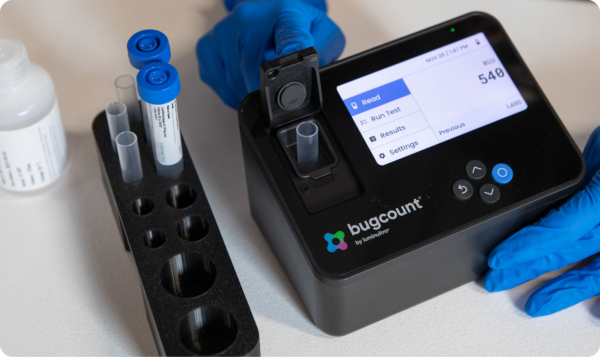
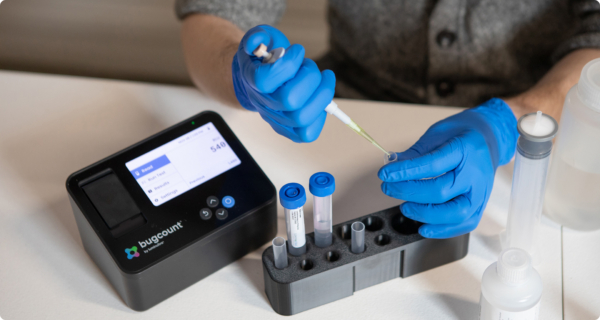
Luminultra introduces the Bugcount® analyzer ATP measurement platform, redefining the standard in microbial testing
The company’s flagship product combines 30 years of microbial expertise with trusted user feedback to produce a next-generation device built to streamline testing, accelerate decisions and strengthen control across critical systems.
Bugcount ,
Wastewater treatment , Drinking water , Legionella management , Microbial contamination , Efficiency loss and biofilm buildup , Biocide management and optimization , Protect product quality , Keep lines running , Stay ahead of MIC , Keep source water clean , Protect reservoir quality , Prevent biofilm build-up , Optimize biocide performance , Commercial aviation , General aviation , Marine , Fuel storage and distribution ,
We bring microbial expertise and deep industry knowledge together to help you solve complex challenges and make confident decisions.


Whether you’re in the lab or in the field, we’re here to help you keep the work on track.

I need help getting started
Have a general inquiry or just need some direction? Send us your question and we’ll get you an answer
I need customer support
Need help with a product or test? Our customer experience team can help


Rethinking water’s role in upstream oil and gas
I spend a lot of time talking about water and microbes, while trying not to sound too nerdy.
Those conversations happen with stakeholders across the oil and gas industry: E&P operators, production chemical service companies, frac companies, water specialists and lab mangers. I have spoken with produced-water experts across North America, from the edges of the Montney in British Columbia to just about every corner of Texas.
Across those conversations, I keep hearing versions of the same story. The quiet thing we do not say often enough is just how important water has always been to the oil and gas industry.
Hydrocarbons may be the commodity, but water is the foundation.
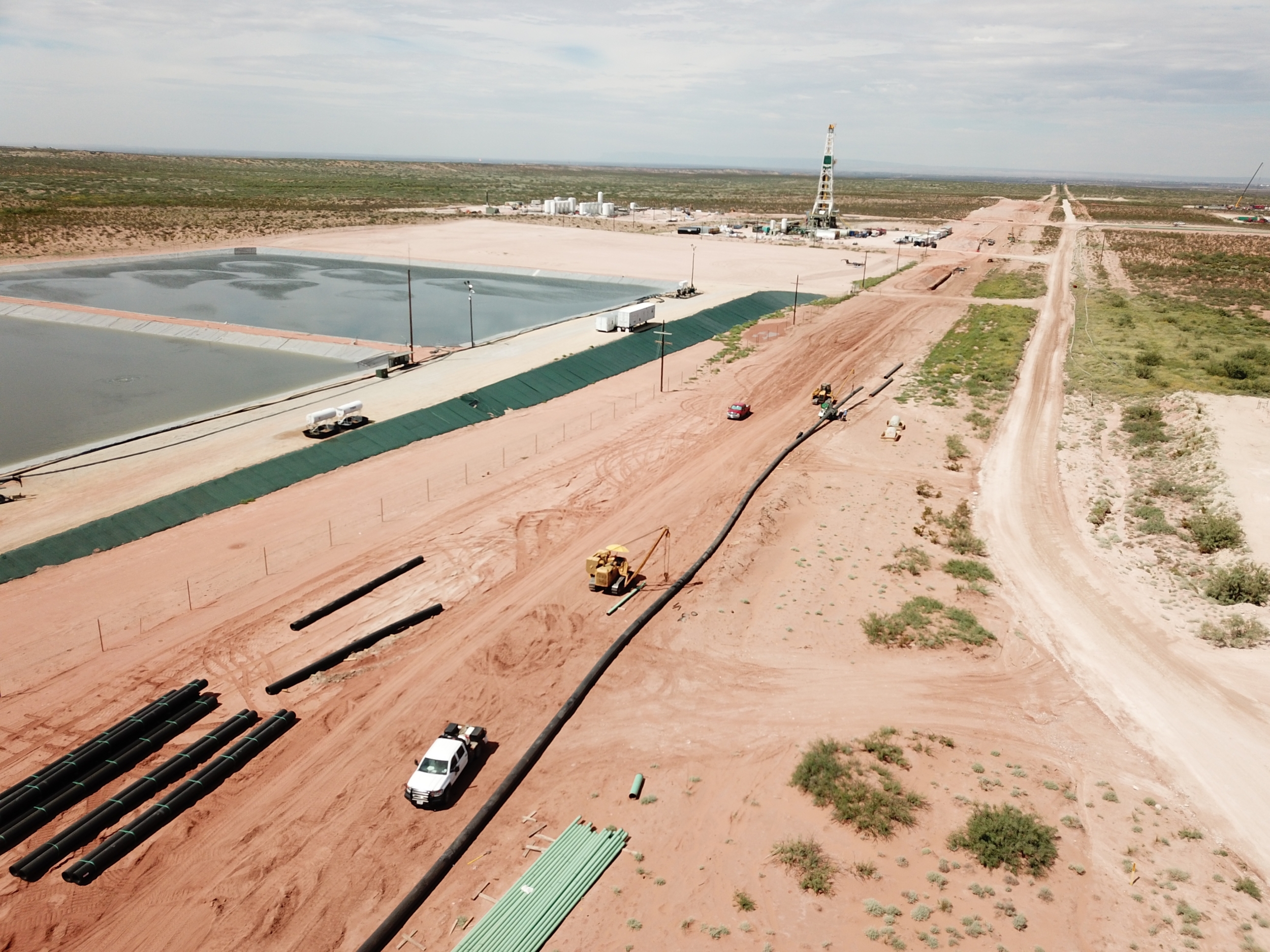
Water has always been part of the system
The upstream oil and gas sector is generally defined as the collective exploration and production activities involved in extracting hydrocarbons from the subsurface. We drill wells, complete them, produce them, and ultimately measure success in barrels of oil or cubic feet of natural gas. But water is present throughout that entire lifecycle. It is used as a tool during drilling and hydraulic fracturing. It supports enhanced oil recovery through waterflooding. It returns to the surface as flowback and produced water. It must then be gathered, transported, treated, stored, recycled, reused, or disposed of safely.
On a global basis, considerably more water is produced than oil. A commonly cited estimate is approximately five barrels of water for every barrel of oil (5:1 water to oil ratio), although the ratio varies significantly by basin, reservoir and asset maturity.
Despite its importance, water has often been treated as a nuisance: separate it from the hydrocarbons, move it away from the production system and dispose of it. That mindset is becoming increasingly difficult to sustain.
The water equation is changing
Changes in regulation, approvals, infrastructure availability, economics, and access to water resources are flipping the traditional equation on its head. Disposal wells are becoming more difficult to permit and develop in many areas. Existing disposal capacity can also become constrained as production grows.
At the other end of the lifecycle, fresh water is not always readily available, or socially, environmentally, or economically practical to use at the scale required for modern completions. At the same time, trucking large volumes of water creates its own costs and risks, including traffic, road damage, emissions, spills, labour requirements and logistical complexity.
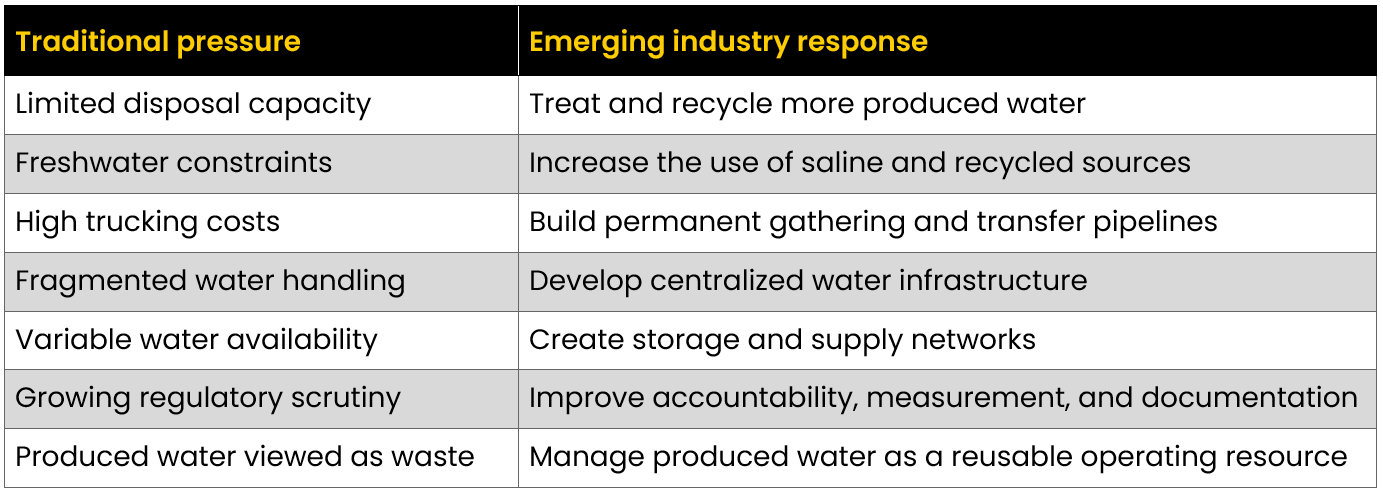
Water sourcing and reuse are therefore becoming strategic concerns rather than secondary operating tasks. As these activities became more important and more technically complex, specialists emerged to fill the expertise and infrastructure gap.
That is how the emerging water midstream sector was born.
The rise of water midstream
Water midstreamers bring together activities that were historically spread across multiple suppliers, operating teams, and temporary systems. They gather produced water, move it through pipelines, treat it, store it, recycle it, deliver it for reuse and manage the portion that still requires disposal. In some cases, they also source and deliver fresh or saline water when recycled supply is insufficient.
This creates significant value for the upstream industry:
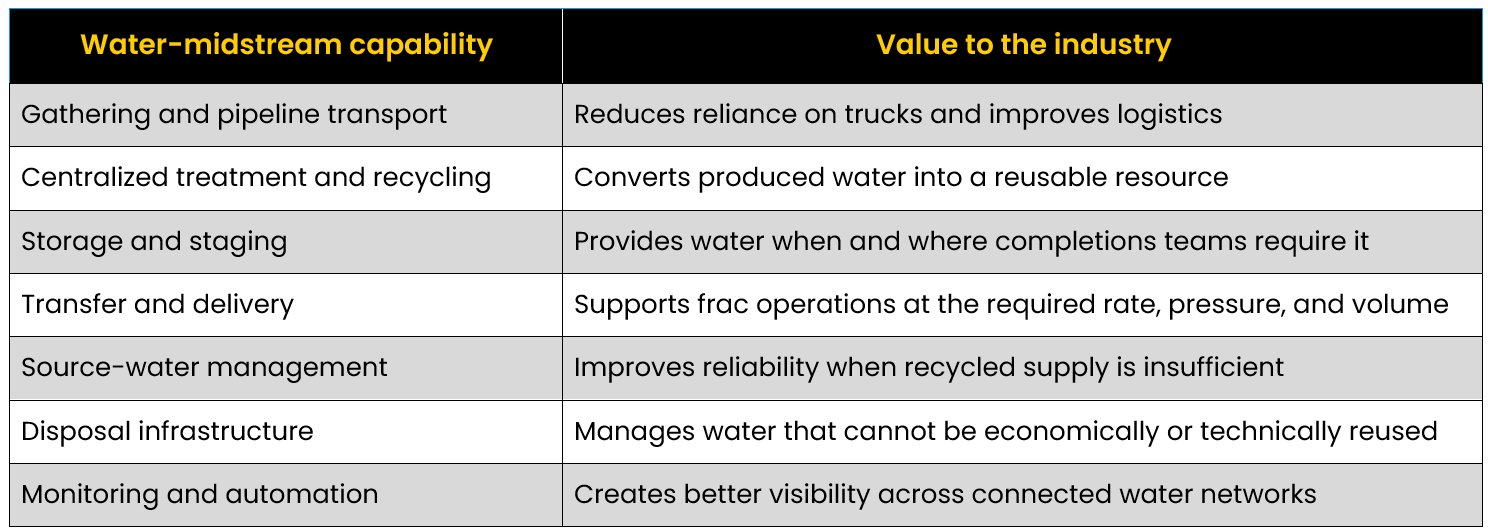
This is why I view water midstreamers as an emerging backbone of upstream oil and gas. They do not simply remove an unwanted fluid. They connect water production, treatment, storage, recycling, and reuse across the basin.
But with that increasingly central role comes a new level of accountability.
Water quality becomes a commercial promise
As the sector grows, so does its responsibility.
A water midstream company may receive produced water from multiple wells, formations, operators, and treatment histories. Those fluids are gathered, commingled, transported, treated, stored, and eventually delivered for reuse.
The water arriving at a hydraulic-fracturing operation must do more than show up at the right volume, pressure, and time. It must be fit for purpose.
That means answering several important questions:
- Is the water chemically compatible with other fluids and the receiving formation?
- Could it cause scale, precipitation, emulsion problems, or iron-polymer deposits?
- Will it work with the intended friction reducer and completion chemistry?
- Is it sufficiently controlled from a microbial perspective?
- Could it introduce souring, biofouling, or corrosion-related threats into the receiving operator’s system?
Adding treatment chemistry is not the same as proving water quality.
As water midstreamers take responsibility for larger, more connected networks, water quality becomes part of the service promise and microbial quality must be included in that promise.
Where there is water, there are microbes
Produced water is chemically challenging, but it is not biologically inactive.
Microbes can survive and grow in high-salinity produced waters, pipelines, tanks, treatment facilities, storage ponds, solids, and biofilms. Their activity can change as waters are mixed, treated, transported, or stored.
Those microbial populations can contribute to several costly problems.
Sulfide-producing microbes can generate hydrogen sulfide and cause a pond, tank, or water network to turn sour. This creates potential worker-safety concerns, odour problems, additional treatment costs, operational restrictions, and customer dissatisfaction.
Biofilm-forming organisms can contribute to plugging, filter loading, solids accumulation, restricted transfer capacity, and treatment inefficiency.
Microbial activity can also contribute to conditions associated with microbiologically influenced corrosion (MIC), threatening pipelines, tanks, disposal systems, and potentially the downstream assets of the operator receiving the water.
The consequences extend beyond the water midstream company’s own infrastructure. When recycled water is delivered to a client, microbes and microbial functions can be transferred into frac tanks, wellbores, reservoirs, production systems, and pipelines.
Without good microbial data, it can be extremely difficult to determine what entered the water network, whether treatment worked, where regrowth occurred, and what was ultimately delivered to the customer.
Safeguarding the value of the water network
Microbial diagnostics give water midstreamers the ability to manage this uncertainty.
Rapid ATP testing can measure changes in total microbial load, establish incoming-water baselines, verify treatment performance, detect regrowth during storage, and confirm microbial control at the point of delivery.
Targeted qPCR and advanced laboratory analysis can then provide greater insight into specific organisms, microbial groups, or functional genes associated with threats such as souring, biofouling, and corrosion.
Together, these tools allow water midstream operators to:
- Adjust treatment when incoming microbial loads change
- Verify that a biocide or oxidizer achieved the intended result
- Detect rebound in ponds, tanks, and transfer pipelines
- Investigate sour-water or H₂S events
- Identify higher-risk sources and locations
- Avoid unnecessary or poorly targeted chemical treatment
- Establish defensible microbial water-quality specifications
- Document the condition of water at custody transfer
This is not testing for the sake of generating more data. It is testing to make better control decisions.
From moving water to delivering confidence
Water midstream companies have an opportunity to differentiate themselves through verified water quality.
The next generation of water midstream service will not be defined only by how much water a company can gather, treat, and deliver. It will also be defined by how confidently that company can demonstrate that the water is suitable for its intended use.
A strong microbial monitoring program provides evidence of what entered the system, what treatment changed, whether control persisted through storage, and what was delivered to the customer. That evidence helps protect infrastructure, optimize chemical programs, strengthen customer relationships, and reduce uncertainty when downstream concerns arise. It also gives water midstreamers something increasingly valuable: the ability to make microbial quality a measurable part of their commercial offering.
Building the industry on better water intelligence
Oil and gas operations are built on water and water midstreamers are becoming responsible for managing that foundation at unprecedented scale.
As produced-water recycling expands and infrastructure becomes more interconnected, microbial blind spots will become increasingly difficult to accept. Water must be managed not only as a volume, but as a dynamic chemical and biological system.
Luminultra helps water midstream companies measure, control, and document microbial quality across the water lifecycle. By combining rapid ATP testing, targeted molecular diagnostics, advanced laboratory analysis, and microbial program expertise, we help ensure that recycled water is genuinely fit for purpose.
Water midstreamers are building the backbone of the modern upstream industry.
Microbial diagnostics can help them protect it and prove the value flowing through it.
Explore Luminultra resources
Make confident decisions with trusted expertise.
Discover webinars, whitepapers and expert articles focused on microbial control.
Are you choosing the right biocide? Or just the familiar one?
Your biocide program is only as good as the condition it’s designed for.
Microbial contamination , Biocide management and optimization , Stay ahead of MIC , Optimize biocide performance ,

A practical primer on using DNA-based microbial diagnostics in oil and gas operations
DNA-based microbial diagnostics, such as quantitative PCR (qPCR) and next-generation sequencing (NGS), are increasingly used as routine tools in oil and gas operations. When combined with ATP testing, these methods allow operators and service companies to better understand microbial risks and apply targeted mitigation strategies as part of everyday field and facility workflows. At their […]
Bugcount , Genecount , Labs ,
Efficiency loss and biofilm buildup , Stay ahead of MIC , Prevent biofilm build-up ,
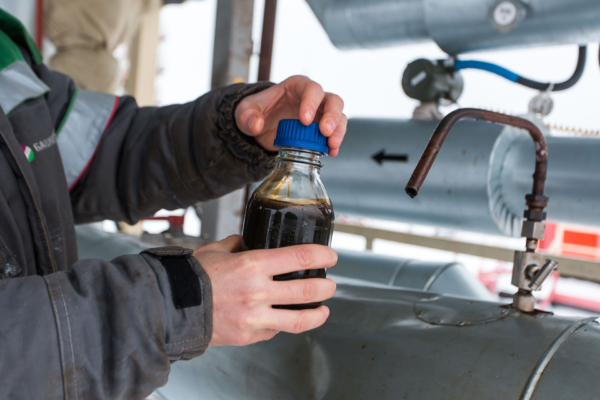
Webinar on demand | Oilfield Microbiology 101 – Foundations for microbial control in oil and gas
Bugcount , Genecount , Labs ,
Stay ahead of MIC , Keep source water clean , Protect reservoir quality , Prevent biofilm build-up , Optimize biocide performance ,

Luminultra introduces the Bugcount® analyzer ATP measurement platform, redefining the standard in microbial testing
The company’s flagship product combines 30 years of microbial expertise with trusted user feedback to produce a next-generation device built to streamline testing, accelerate decisions and strengthen control across critical systems.
Bugcount ,
Wastewater treatment , Drinking water , Legionella management , Microbial contamination , Efficiency loss and biofilm buildup , Biocide management and optimization , Protect product quality , Keep lines running , Stay ahead of MIC , Keep source water clean , Protect reservoir quality , Prevent biofilm build-up , Optimize biocide performance , Commercial aviation , General aviation , Marine , Fuel storage and distribution ,
Protect Performance, Preserve Production: The Operator’s Guide to Microbial Risk Management
Bugcount , Genecount , Labs , Polytechnic , Relay ,
Stay ahead of MIC , Keep source water clean , Protect reservoir quality , Prevent biofilm build-up , Optimize biocide performance , Unified testing and reporting ,
Protect Performance, Operations and Profit: The Service Company’s Guide to Microbial Risk Management
Bugcount , Genecount , Labs , Polytechnic , Relay ,
Stay ahead of MIC , Keep source water clean , Protect reservoir quality , Prevent biofilm build-up , Optimize biocide performance , Unified testing and reporting ,

Webinar on demand | Two-part series: Microbial risk mitigation and biocide application mechanics
Bugcount , Genecount , Labs , Polytechnic ,
Stay ahead of MIC , Keep source water clean , Protect reservoir quality , Prevent biofilm build-up , Optimize biocide performance ,

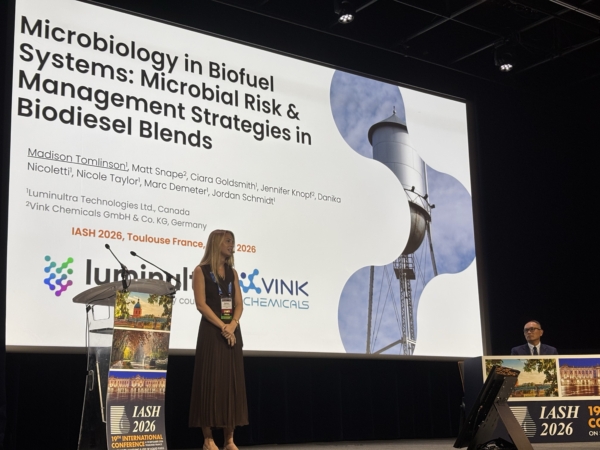
Luminultra Applications Scientist Madison Tomlinson recognized with Chevron Research Award of Excellence
Research conducted in collaboration with Vink Chemicals explores microbial management strategies in biodiesel blends Fredericton, New Brunswick – September 9, 2026 – Luminultra is proud to announce that Applications Scientist Madison Tomlinson has been selected to receive the Chevron Research Award of Excellence in Honor of John Bacha from the International Association for Stability, Handling […]
Bugcount ,
Fuel storage and distribution ,
Download our Kill Study Template to optimize your biocide strategy
Bugcount ,
Optimize biocide performance ,
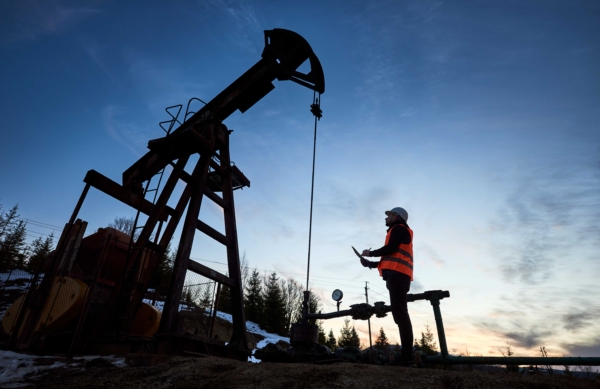
When it comes to microbes, “everything is everywhere”
Marc Demeter, our Director of Market Development, shares his expertise on managing microbial threats in the oil and gas industry.
Polytechnic ,
Stay ahead of MIC , Keep source water clean , Protect reservoir quality , Prevent biofilm build-up , Optimize biocide performance ,

Not sure what you need? Let’s figure it out together
Talk to a Luminultra expert and get clear answers, fast.